
The Chessboard In Manila: Trump’s Asia Trip, Square by Square
By Peter Navarro | November 18. 2026 | RealClearMarkets
Most coverage of President Trump’s trip to Asia this week reads like a travel log. Manila on Tuesday. Malacañang Palace on Wednesday. Then Shenzhen, Xi Jinping, and an expected meeting with Xi and Vladimir Putin.
Read it as a chessboard. Every stop in Manila moved a piece, and every piece bears on the same challenge.
Start with the smallest square. It shows the pattern.
THAILAND: THE MODEL
On Tuesday the President and Prime Minister Anutin Charnvirakul signed a joint statement confirming that the Agreement on Reciprocal Trade is substantially concluded. The final text follows in the coming weeks. The terms are already clear.
Thailand needed this deal more than we did. America buys about a quarter of everything Thailand exports. Our goods deficit with Thailand was $72 billion last year. Through September of this year it is already $85 billion, the fifth largest we run with any country. That number must come down.
So we keep our tariffs on Thai goods. Thailand drops its tariffs on ours. “Thailand will eliminate all tariffs on U.S. exports,” the President said. Thailand also takes down the walls behind the tariffs. It will accept cars built to American safety and emissions standards. It will accept FDA approvals for drugs and medical devices. It will license American ethanol and speed American meat and poultry to market.
Thailand buys American. The framework the two governments announced last year spells it out: Liquefied natural gas, crude oil and ethane, about $5.4 billion a year. Eighty American aircraft, $18.8 billion. Feed corn, soybean meal and distillers grains from our farmers at about $2.6 billion.
And Thailand cleans up. There are four ways a country cheats its way to a surplus: sweatshop labor, a dirty environment, and stolen intellectual property represent three. Thailand commits to enforce against forced labor and child labor. It commits to fight illegal logging and illegal fishing. It commits to go after the counterfeiters and pirates who rob American inventors.
The fourth way, and the clause that addresses it, matters more than the rest. Thailand agrees to work with us against duty evasion. Chinese goods that pass through a Thai port and pick up a new label to dodge American tariffs will find the door shut.
That’s the Great Transshipment Scam that Customs and Border Protection and my office are working hard to crack down on. It’s a scam China runs that drains tens of billions of dollars out of our treasury every year.
This is what American market power looks like when a President is willing to use it. Every other capital in Southeast Asia can read the terms.
ASEAN: BEIJING’S VETO, AND THE WAY AROUND IT
ASEAN, the Association of Asian Nations, is a harder square. It acts only by consensus, and that hands Beijing a veto it never has to cast itself. It’s client states Cambodia and Laos cast it.
In 2012, with Cambodia in the chair, ASEAN’s foreign ministers failed to issue a joint communiqué for the first time in the bloc’s history. The sticking point was the South China Sea. In 2016, days after an international tribunal threw out China’s claims there, Cambodia kept any mention of the ruling out of ASEAN’s statement.
So the President does not wait for ASEAN. He goes country by country. Malaysia, Indonesia and now Thailand are working out trade deals with us. So does even Cambodia, which shows that American leverage reaches places ASEAN consensus cannot.
The piece that matters most is the host of the summit. The Philippines anchors the First Island Chain, the line of islands that stands between China’s navy and the open Pacific. Malaysia, Brunei, Vietnam and Indonesia all have waters that China claims. For the Philippines the threat is existential. In one week this July, Chinese coast guard ships turned water cannon on Philippine vessels at Scarborough Shoal two days running, and Manila accused Chinese personnel of clubbing a Filipino sailor at Second Thomas Shoal.
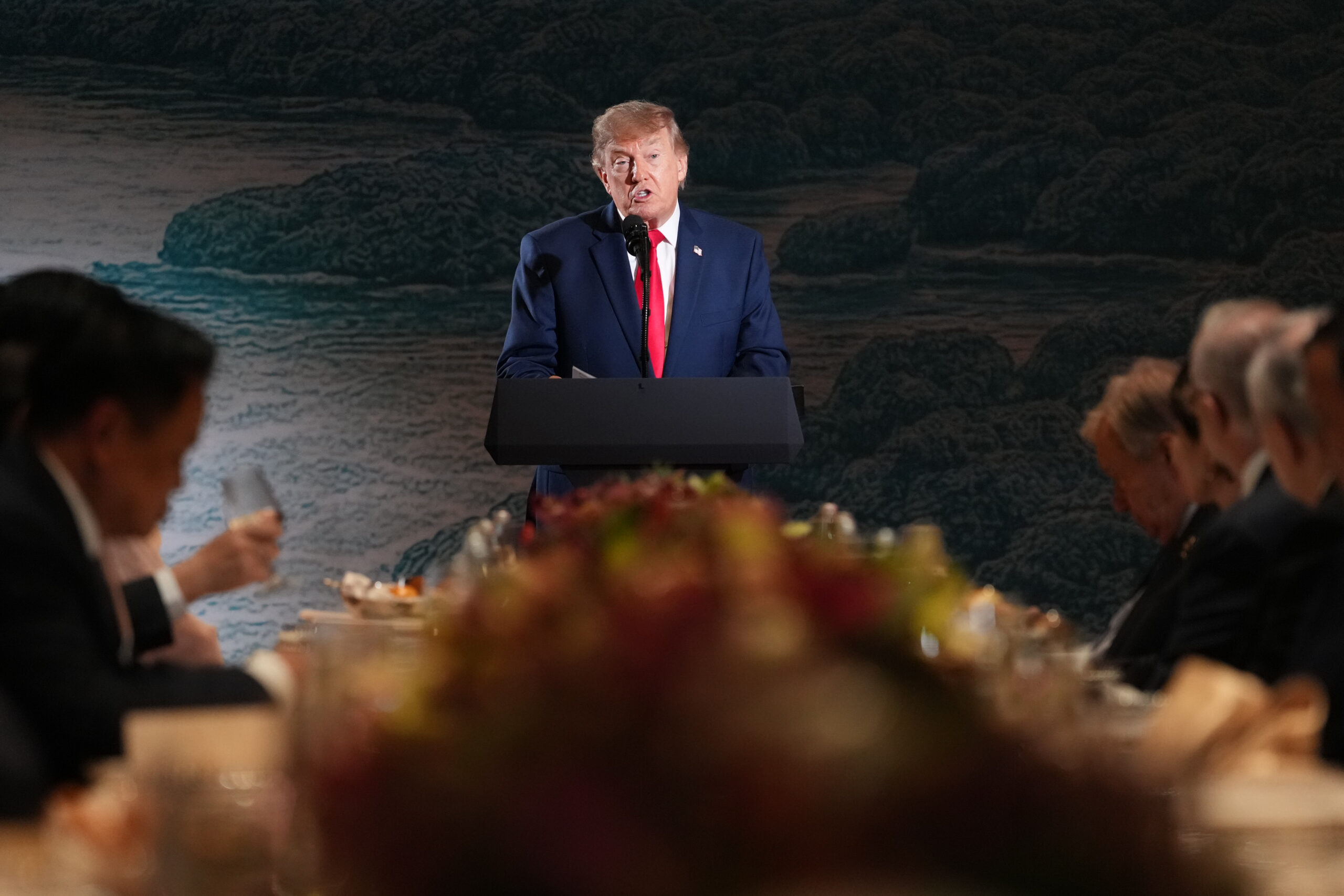
On Wednesday the President goes to Malacañang Palace, with the 1951 Mutual Defense Treaty on the agenda. He told the ASEAN leaders at dinner where he stands: “We support our partners and our allies 100%.”