
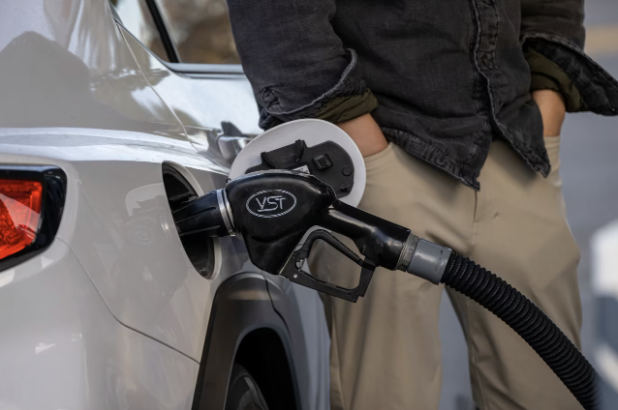
The risk of regime violence has long been baked into the global price of oil and gas—and everything else.
By Peter Navarro | Wall Street Journal | March 13, 2026
President Trump’s decision to confront Iran’s advancing nuclear program, stockpiles of ballistic missiles, and promotion of terrorism addresses an urgent national-security threat. It also tackles an overlooked problem: For more than four decades, Iran’s rogue behavior has imposed a hidden tax on the world economy through higher oil prices and slower growth. Call it the “Iran Terror Premium.”
Roughly a quarter of the world’s seaborne oil trade transits the Persian Gulf, much of it through the narrow Strait of Hormuz. When markets price crude oil, they must account for the risk that conflict, sabotage and terrorism will interrupt these flows. Iran creates that risk through its own forces and through proxy groups such as Hezbollah, Hamas, the Houthis and militias in Iraq, which have targeted energy infrastructure, shipping routes and regional oil facilities.
Even when no oil fields are shut down and no tankers are blocked, the risk of disruption itself pushes prices higher. In this way, oil markets behave like insurance markets: The greater the perceived risk, the larger the premium.
Economists and market analysts have measured this effect in several ways. Dario Caldara and Matteo Iacoviello’s Geopolitical Risk Index is often used to show that spikes in geopolitical tension are accompanied by higher oil prices. Research by Lutz Kilian, Michael Plante and Alexander Richter at the Federal Reserve Bank of Dallas finds that even an increasing probability of supply disruption can push oil prices higher. Market analysts—from major banks to surveys of energy economists—commonly estimate that tensions involving Iran add roughly $5 to $15 a barrel to global oil prices under normal conditions. During major crises, like today’s, oil prices may surge above $100 a barrel.